Table of Contents
- Start With the Charter Details That Shape Your Yacht Charter Packing List
- The Yacht Charter Dress Code: What to Wear on Deck and Ashore
- What to Pack for a Day Boat Trip: The Core Essentials
- Tipping Etiquette for Yacht Crew: What Guests Get Wrong
- Provisioning vs. Personal Items: Who Brings the Food and Drinks?
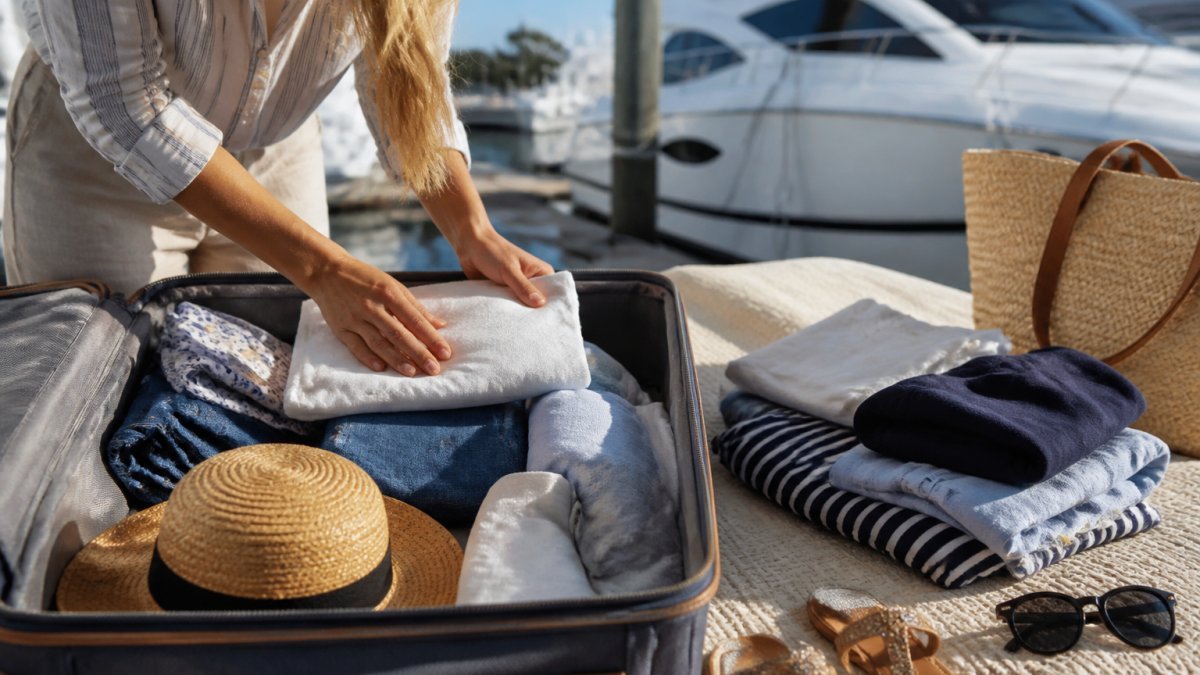
- Cabin Storage, Soft-Sided Luggage, and Packing for Tight Quarters
- What to Leave Behind: Prohibited Items and Customs Documentation
- Sustainable Yacht Charter Packing: Small Choices That Protect the Marine Environment
- Frequently Asked Questions
Last Updated: September 30, 2026
Start With the Charter Details That Shape Your Yacht Charter Packing List
The biggest mistake with yacht charter packing is packing before you know what kind of trip you’ve booked. A day sail and a bareboat week demand completely different bags. This guide from Palm Beach Charters breaks down what to bring on trips of every length.
Day Trip, Overnight, or Bareboat: Three Different Bags
A day charter is a carry-on mindset: one soft-sided bag, sun protection, and nothing you’d mourn if it got splashed. An overnight or skippered charter adds a change of clothes, toiletries, and medication. A bareboat charter, where you captain the vessel yourself, means packing for a floating household.
- Day trip: tote or small backpack, reef-safe sunscreen, polarized sunglasses, a windbreaker
- Overnight or skippered: add a duffel with one change of clothes and personal toiletries
- Bareboat: add provisioning, cooking basics, and anything the charter agreement says the vessel doesn’t supply
Ask your charter operator for the vessel’s layout before you pack. A cabin with a hanging locker takes a garment bag; a bunk-only cabin takes a soft duffel and nothing else.
The Yacht Charter Dress Code: What to Wear on Deck and Ashore
The yacht charter dress code is casual on deck and smart-casual ashore, with one hard rule: footwear must have non-marking soles. Boat decks scuff easily, and most operators ask guests to leave street shoes below.
Footwear Rules: Non-Marking Soles and Deck Shoes
Deck shoes with non-marking soles are the only footwear that belongs on a yacht’s surface. White-soled boat shoes, sailing sneakers, and closed-toe sandals with rubber treads qualify; black-soled running shoes and heels are the common offenders. Bring two pairs maximum: one deck-safe, one for ashore.
What to Pack for a Day Boat Trip: The Core Essentials
For a day boat trip, pack light: sun protection, one layer for wind, a waterproof way to carry your phone, and nothing valuable that can’t get wet. Everything fits in a single soft-sided bag.
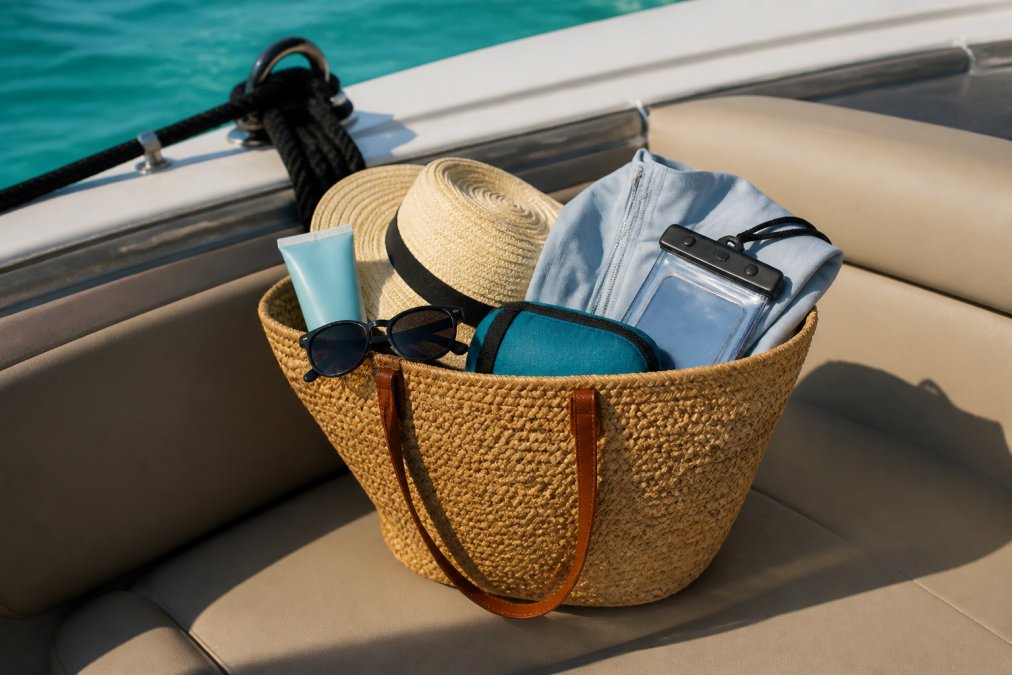
Here’s the numbered list I’d hand a first-timer:
- Reef-safe sunscreen, SPF 30 or higher
- Polarized sunglasses with a strap
- Wide-brim hat with a chin cord
- Light windbreaker or packable shell
- Rash guard or UV shirt
- Waterproof phone case
- Dry bag for anything that must stay dry
- Reusable water bottle
- Seasickness medication, taken before you board
- Small towel
Sun, Skin, and Sea: Protection That Actually Works
Reef-safe sunscreen matters on two fronts: it protects you and the marine environment you came to see. Mineral formulas with zinc oxide or titanium dioxide are the standard. Apply before you board and reapply every two hours.
First Aid and Medication: The Kit Most Guests Forget
A day charter has no pharmacy within reach, so the first aid and medication you bring is the only kit on board besides required safety equipment. Build a small, flat pouch that lives at the top of your bag.
Medication to bring:
- Seasickness medication. Most options work best taken 30 to 60 minutes before boarding, not after symptoms start. Common choices include meclizine, dimenhydrinate, and prescription scopolamine patches. Some cause drowsiness, so test at home first. Ginger chews and acupressure wristbands are drug-free alternatives.
- Personal prescriptions in original labeled containers, plus a few extra days’ supply in case the trip runs long.
- Pain reliever and antihistamine for headaches, sun reactions, or insect bites ashore.
- Motion-sickness backup if the first option doesn’t agree with you.
First aid supplies to bring:
- Adhesive bandages in assorted sizes and blister cushions
- Antiseptic wipes and antibiotic ointment
- Motion-sickness and anti-itch creams
- Aloe vera or after-sun lotion for sunburn
- Tweezers for splinters and sea urchin spines
- Electrolyte packets for heat and dehydration
- Any personal medical devices, plus spare batteries or supplies
Tell your captain about any serious medical condition, allergy, or medication before you board. In an emergency, the crew needs to know what you carry and where it is. If you use an epinephrine auto-injector or inhaler, keep it on your person, not buried in a bag below deck.
Water Sports and Snorkeling Gear: What to Bring vs. What’s Provided
Snorkeling gear is the item guests most often assume is included and most often find is not. Confirm before you pack.
- Mask and snorkel: Bring your own if you wear a prescription mask or have a hard-to-fit face; rental masks rarely seal well.
- Fins: Bulky and the most likely item to be provided. Ask before you dedicate luggage space.
- Rash guard or dive skin: Protects against sun, jellyfish stings, and coral scrapes.
- Water shoes: Essential for rocky shorelines and reef entries; choose non-marking soles so they double as deck shoes.
- Dry bag: Keeps a towel, phone, and wallet dry on the tender ride.
- Reef-safe sunscreen: Reapply before and after every swim.
Electronics, Dry Bags, and Charging on Board
A dry bag is the one piece of gear experienced charter guests never skip: a roll-top waterproof sack that keeps phones, wallets, and cameras dry through spray and rain.
Taking seasickness medication after you feel sick is too late. Most options work best taken 30 to 60 minutes before boarding, and some cause drowsiness, so test them at home first.
Tipping Etiquette for Yacht Crew: What Guests Get Wrong
Tipping etiquette for yacht crew follows a simple principle: the crew is a service team, and gratuity reflects the level of service. For a crewed charter, 10% to 15% of the charter fee is customary. For a day trip with a captain only, a flat cash tip is standard.
- Crewed charter, multi-day: 10-15% of the charter fee
- Crewed day charter: a flat cash amount per crew member
- Bareboat with a hired skipper: tip the skipper directly
Provisioning vs. Personal Items: Who Brings the Food and Drinks?
Provisioning is the food and beverage supply for the trip, and whether you handle it or the operator does depends on your charter agreement. On a crewed or skippered charter, meals and drinks are often included or an add-on. On a bareboat charter, you provision the vessel yourself before departure.
| Category | Who supplies it | Examples |
|---|---|---|
| Provisioning | Operator or you, per agreement | Meals, beverages, ice, snacks |
| Personal items | Always you | Medication, toiletries, personal clothing |
| Shared gear | Usually the vessel | Safety equipment, cookware, linens |
| Specialty gear | Always you | Snorkeling gear, fishing tackle |
Cabin Storage, Soft-Sided Luggage, and Packing for Tight Quarters
Soft-sided luggage is the rule on almost every yacht, and the reason is storage geometry. Cabins have odd-shaped lockers, under-bunk spaces, and hanging lockers rather than rectangular closets, and a hard-shell suitcase fits none of them well.
Catamaran vs. Monohull: Two Very Different Bags
Most packing guides treat “yacht” as one thing. It isn’t. The hull you book changes how much you can bring and how you pack it.
Catamaran:
- Wider beam means more cabin volume and storage per guest.
- Cabins often have a hanging locker, drawers, and under-berth space.
- A soft garment bag or medium duffel fits comfortably.
- You can usually bring a second pair of shoes and a fuller toiletry kit.
- Twin hulls sit flatter at anchor, which matters for motion-sensitive guests.
Monohull:
- Narrower beam and heeled sailing mean less usable storage and more shifting gear.
- Cabins lean toward a bunk, a small shelf, and a single hanging locker.
- A compressible duffel is the only bag that reliably fits.
- Limit yourself to one pair of deck shoes plus one pair for ashore.
- Anything loose slides when the boat heels; packing cubes and a cinch strap keep contents in place.
The Provisioning Line: What the Boat Supplies vs. What You Bring
Storage pressure comes from two directions: your personal gear and the trip’s food and drinks. Knowing which is which keeps you from hauling groceries the operator already stocks, or arriving with nothing to eat on a bareboat.
| Category | Who supplies it | Examples |
|---|---|---|
| Provisioning | Operator or you, per agreement | Meals, beverages, ice, snacks |
| Personal items | Always you | Medication, toiletries, personal clothing |
| Shared gear | Usually the vessel | Safety equipment, cookware, linens |
| Specialty gear | Always you | Snorkeling gear, fishing tackle |
If you’re provisioning a bareboat, buy collapsible containers and soft-sided coolers instead of rigid ones. They flatten as food is consumed, freeing storage that hard-sided coolers never give back.
The best yacht charter packing list is built around the vessel, not the destination. Match your bag to the hull type and the provisioning plan, and everything else falls into place.
What to Leave Behind: Prohibited Items and Customs Documentation
Prohibited items on a charter typically include anything with a black sole, hard-shell luggage, and items the vessel’s safety rules restrict. Some operators also prohibit certain foods, glass containers, and open flames.
Sustainable Yacht Charter Packing: Small Choices That Protect the Marine Environment
Sustainable packing starts with reef-safe sunscreen and reusable bottles, then extends to everything else in your bag. The marine environment is the reason you’re out there, and a few swaps keep it that way.
- Reef-safe sunscreen instead of chemical formulas
- Reusable water bottle instead of single-use plastic
- Dry bag instead of plastic zip bags
- Reusable snack containers instead of wrapped singles
- No single-use straws or cutlery
Frequently Asked Questions
What is the 12 person rule on a yacht?
Under U.S. Coast Guard rules, uninspected recreational vessels carrying more than 12 passengers for hire fall into a different certification category. Many crewed yacht charters that operate as uninspected vessels cap guest counts at 12 to stay compliant. If your group is larger, the operator may need a vessel with a Certificate of Inspection, which changes both the boat and the paperwork. Always confirm your headcount with the charter company before booking.
How much are you supposed to tip on a yacht charter?
Customary tipping etiquette for yacht crew runs 10 to 20 percent of the charter fee, with 15 percent being a common middle ground for good service. On crewed charters, the tip is usually split among the captain, steward, and deckhand. Hand it to the captain in an envelope at the end of the trip. For a day charter with a single captain, a flat $100 to $200 is reasonable depending on group size and effort.
What to wear for a day on a yacht?
The yacht charter dress code is smart casual with a nautical lean. Wear lightweight, quick-drying fabrics, a swimsuit under your clothes, and a rash guard for sun exposure. Bring a windbreaker for open-water breezes and a light layer for the ride back. Avoid dark-soled shoes that scuff decks; non-marking soles or deck shoes are standard. Skip loose jewelry and anything that can snag on rails or blow overboard.
Does a yacht charter include food and beverages?
It depends on the charter type. Crewed yachts often include meals prepared in the galley, while bareboat and skippered charters usually leave provisioning to you. Some operators offer add-on catering packages or a stocked bar for an extra fee. Ask specifically what is included versus what costs extra, and whether you can bring your own alcohol. For day trips, packing a small cooler with snacks and refillable water bottles covers the gaps.
What should I leave behind when boarding a luxury yacht?
Leave hard-soled shoes with black or marking soles, large hard-shell suitcases that do not fit cabin storage, and anything with open flames or fireworks. Skip illegal substances, weapons, and drones unless the captain approves. Strong-smelling foods, glitter, and spray tan products can stain upholstery and are best avoided. Also leave behind expectations of full-size toiletries; travel sizes fit better and reduce weight on board.
Are there specific footwear requirements for yacht decks?
Yes. Most yachts require non-marking soles to protect teak and fiberglass decks. White-soled sneakers or dedicated deck shoes work well. You will often be asked to remove shoes entirely before stepping below deck. Bring a pair of sandals with soft soles for the dock and a separate pair of deck shoes for the boat. Avoid heels, hard leather soles, and any shoe that has been worn in mud or gravel.
What should I pack for a day boat trip to keep electronics safe?
A waterproof phone case and a dry bag are the two items most guests forget. Saltwater and spray damage phones quickly, and a dry bag protects cameras, wallets, and keys during snorkeling or dinghy rides. Bring a portable power bank since outlets on deck are limited, and consider a power inverter if you need to charge a laptop. Polarized sunglasses cut glare on the water, and a headlamp helps if you stay out past sunset.
How do I pack sustainably for a yacht charter?
Use reef-safe sunscreen that avoids oxybenzone and octinoxate, which are linked to coral damage. Bring a refillable water bottle instead of single-use plastics, and pack snacks in reusable containers. Choose soft-sided luggage made from recycled materials where possible. Avoid glitter, single-use straws, and anything that can blow overboard and enter the marine environment. Small choices add up when thousands of charters run the same routes each season.