Last Updated: October 28, 2026
Quick Summary
Verify yacht charter cleanliness by inspecting the vessel in person before you unpack, starting at the dock and working from the outside in with a flashlight and white tissues. Check the cabin, head, galley, high-touch points, and water systems, and ask the operator for written cleaning protocols and freshwater tank flush dates before you pay a deposit.
- Run the boarding checklist in about 15 minutes before you unpack or open a drink.
- A clean boat smells neutral, not perfumed, so question strong air freshener in a small bathroom.
- Ask operators in writing about turnaround hours, cleaning staff, and written cleaning protocols before paying a deposit.
- Request the freshwater tank’s last flush date and ask whether potable water is filtered at the tap.
- Photograph any issue with scale, note the location, and tell the captain immediately in person.
Table of Contents
- Why Yacht Charter Cleanliness Deserves a Closer Look
- The Yacht Charter Cleaning Checklist to Run Before Boarding
- Questions to Ask a Yacht Charter Company About Cleanliness
- Your Charter Yacht Inspection Checklist for Systems and Safety
- Yacht Freshwater Tank Testing and Water Quality Checks
- How to Document and Report Cleanliness Problems On Board
- Separating Cleanliness Issues From Safety and Maintenance Defects
- Booking a Charter You Can Board With Confidence
- Frequently Asked Questions
Why Yacht Charter Cleanliness Deserves a Closer Look
Knowing how to verify yacht charter cleanliness is the difference between a spotless day on the water and a boarding-day letdown.
So check the boat yourself, in person, before you settle in.
Yacht charter cleanliness is the verifiable condition of a vessel’s interior, exterior, water systems, and high-touch surfaces at the moment guests board. It covers what you can see, smell, and test, not just what a listing claims.
This guide gives you a guest-facing checklist, the questions to ask before you book, and a simple way to report problems. For a baseline of what a charter normally includes, see what is included in a luxury yacht charter.
The Yacht Charter Cleaning Checklist to Run Before Boarding
Run this yacht charter cleaning checklist in about 15 minutes, before you unpack or open a drink. Start at the dock and work from the outside in.
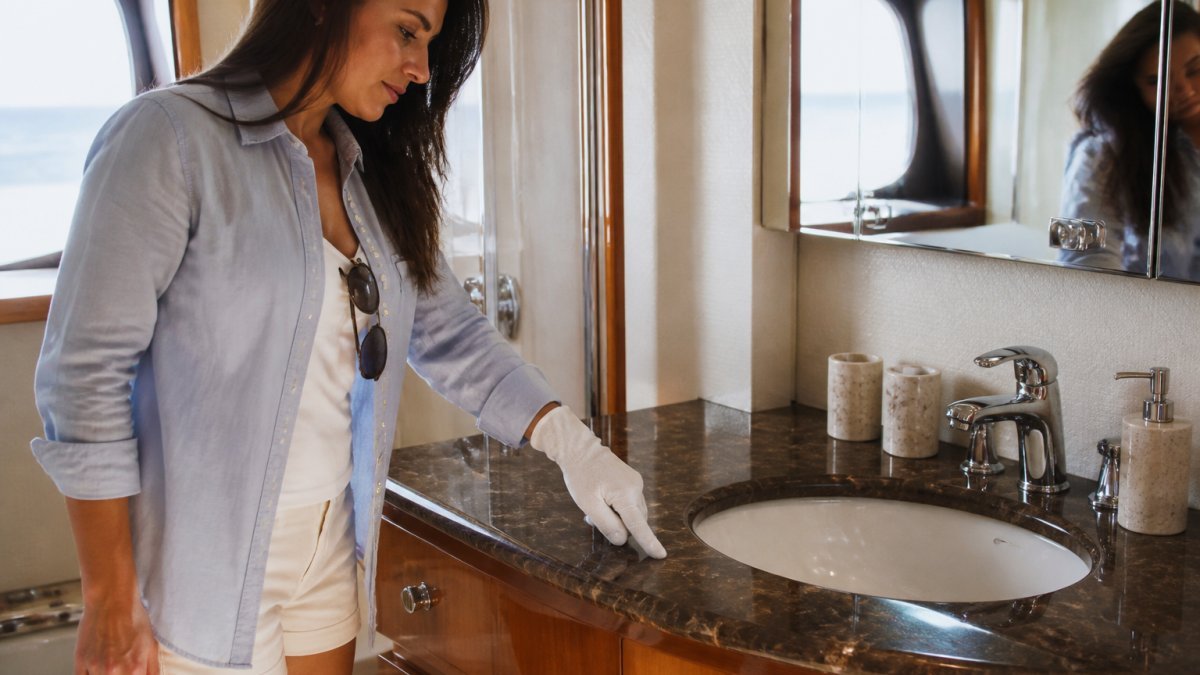
Walk the exterior first:
- Check the deck for standing water, grit, or sticky spots
- Look at cushions and seat covers for stains or damp patches
- Inspect cup holders, railings, and grab bars for grime
Then move inside. Open the cabin, sniff the air, and look up at the ceiling vents. A clean boat smells neutral, not perfumed.
Cabin and Bathroom Inspection Criteria
The cabin and head tell you the most. A rushed cleaning job almost always shows up here first.
Check these points:
- Bedding and linens: fresh, dry, no wrinkles from reuse
- Mattress and pillows: no stains, no musty smell
- Bathroom mirror and fixtures: no water spots or film
Watch out: a strong air freshener in a small bathroom often masks a ventilation or drain problem. Ask why it is there.
Galley, High-Touch Points, and Exterior Surfaces
High-touch points get skipped in quick turnarounds. Check them with your own hands, not your eyes.
Run a tissue along these spots:
- Refrigerator handle, ice bin lid, and cooler latches
- Handrails, stair rails, and door handles
- Light switches and cabinet pulls
In the galley, look inside the fridge and microwave. Check under the cutting board. If food prep gear is sticky or smeared, the deep clean did not happen. On deck, check the swim platform and boarding ladder for algae or slime. That film is a slip risk, not just a cosmetic issue.
Questions to Ask a Yacht Charter Company About Cleanliness
Most guides tell you to inspect the boat on the day. That is too late to change operators. The questions below are designed to be asked before you pay a deposit, when you still have leverage. Ask them in writing, email or the booking platform’s message thread, so the answers become part of your record.
Group them into four buckets so you can compare operators side by side.
Turnaround and staffing
- How many hours are scheduled between the previous charter’s disembarkation and my boarding?
- Is the boat cleaned by the operating crew, a dedicated housekeeping team, or a third-party contractor?
- How many people clean the vessel, and is the same team assigned each time? A named lead cleaner is a good sign.
Protocol and products
- Can you send me your written cleaning protocol or turnaround checklist?
- Which cleaning products do you use on interior surfaces, and are fragrance-free or low-VOC options available on request? This matters if anyone in your group has asthma, allergies, or chemical sensitivity (the EPA).
- How do you handle upholstery, teak, and other high-end materials, are they cleaned with material-specific products or a general-purpose spray?
Water and systems
- When was the freshwater tank last flushed, and can I see the log entry? Ask for the date, not a promise.
- Is potable water filtered at the tap, and is the filter changed on a set schedule?
- When was the bilge last pumped and the holding tank last serviced?
Remediation and escalation
- If I find a cleanliness issue at boarding, who is my point of contact, and what is the response window? Get a name and a phone number, not a general inbox.
- What is your policy if a cleanliness issue cannot be resolved on the day, partial credit, re-clean, or rebooking? Ask for the answer in writing before you pay.
- Can I board 15 minutes early to inspect before the charter clock starts? Operators confident in their turnaround say yes.
Send the same list to three operators and compare the answers side by side.
If you have specific concerns, contact our charter team and ask directly. A company that welcomes the question usually has nothing to hide.
Your Charter Yacht Inspection Checklist for Systems and Safety
A charter yacht inspection checklist goes beyond surfaces. Diligent scrutiny of the vessel’s history requires that you verify inspection reports to ensure that past mechanical concerns have been properly addressed before you commit to your voyage.
Run this checklist with the captain or base manager present, ideally during the handover briefing.
Engine and mechanical compartment (visual only)
- Compartment looks dry, with no fuel or oil film on the pan
- No rust streaks on cooling hoses or clamps
- No strong fuel or exhaust smell when the hatch is open
Water and waste systems
- Freshwater tank log shows a flush date within the operator’s stated interval
- Taps run clear, with no discoloration or sulfur smell
- Head flushes properly and the bowl holds water
Safety equipment
- Life jackets are dry, clean, and sized for every person in your group, including children
- Fire extinguishers show a current inspection tag and a charged gauge
- First aid kit is stocked, sealed, and within its expiration dates
- Flares are in date (check the stamped date, not the box)
The U.S. Coast Guard boating safety resources outline the safety gear a vessel should carry.
Navigation and communication
- VHF radio powers on and transmits on a test channel
- Chartplotter and depth sounder boot up and show a position fix
- AIS (if equipped) shows nearby traffic
- Cell signal or satellite communicator is available for offshore legs
A dirty or damp safety item is a stop-and-ask moment, not a cosmetic note. If life jackets are damp or mildewed, ask for replacements before you leave the dock. If a fire extinguisher is past its inspection date, ask the captain to swap it or document the discrepancy in writing.
How to read what you find
Not every finding is a dealbreaker. Sort them:
- Cosmetic or cleaning: smudged surfaces, dusty vents, water spots. Ask crew to re-clean; do not escalate.
- Maintenance: cracked handrail, loose fitting, weak tap flow. Report to the captain before use; ask when it will be fixed.
- Safety: fuel smell, frayed wiring, expired extinguisher, missing life jacket size. Do not board until resolved, and get the resolution in writing.
Cleanliness and safety are separate checks, a spotless galley does not tell you the extinguisher is current, and a current extinguisher does not tell you the head was cleaned. Run both.
Yacht Freshwater Tank Testing and Water Quality Checks
Yacht freshwater tank testing matters more than most guests realize. You will drink that water, wash food in it, and shower in it. Ask two direct questions: when was the tank last flushed, and when was the water last sampled?
You can ask about:
- The last flush date for the freshwater tank
- Whether water was sampled and analyzed recently
- How often the system gets a full check-up
- Whether potable water is filtered before it reaches the tap
For broader context on drinking water standards, the EPA’s drinking water information explains what safe water testing looks for. Ask to see the boat’s water log if one exists.
How to Document and Report Cleanliness Problems On Board
Report problems the moment you find them, with evidence. A photo taken at boarding time is worth more than a complaint sent a week later.
Follow these steps:
- Photograph the issue with something for scale, like a coin or your hand
- Note the exact location: cabin, head, galley, or deck
- Tell the captain or crew immediately, in person
- Ask what they can fix now, and get a clear answer
- Write down the time and who you spoke to
- Follow up in writing after the trip if it was not resolved
Keep it factual. “The bathroom drain had visible hair and the mirror was spotted at 10:15 a.m.” lands better than “the boat was dirty.”
Watch out: waiting until the end of the trip to raise a concern limits what the crew can do. Speak up early.
Separating Cleanliness Issues From Safety and Maintenance Defects
Not every problem is a cleaning miss. Sort them correctly and you get a faster, fairer response.
| What you see | Likely category | What to do |
|---|---|---|
| Smudged mirror, crumbs in a drawer | Cleanliness | Ask crew to re-clean |
| Musty smell in a cabin | Cleanliness or ventilation | Request a different cabin or airing out |
| Sticky residue on rails | Cleaning product residue | Ask for a rinse and wipe |
| Cracked handrail, loose fitting | Maintenance defect | Report to captain before use |
| Frayed wiring, fuel smell | Safety defect | Do not board until resolved |
| Weak water flow at taps | System issue | Ask for a system check |
The line matters. A smudged counter is a cleaning fix. A fuel smell is a stop-and-check moment. Treat them differently, and you will be taken seriously on both.
Allergen and odor concerns belong in the cleanliness column too. If strong cleaners bother you, say so before boarding.
Booking a Charter You Can Board With Confidence
When you are ready to compare boats, browse our private charter fleet in West Palm Beach and ask each operator the questions above. Bring our packing guide for what to bring on a yacht charter so you arrive ready to inspect, not scramble.
At Palm Beach Charters, we run exclusive private boat tours and luxury yacht experiences across South Florida. Our fleet includes luxury yacht class options, and we offer bachelorette parties, sunset cruises, and specialized tours to Peanut Island.
Frequently Asked Questions
How can you tell if a charter yacht is clean before you book?
Ask for recent interior photos, then check that the images show current upholstery, dry carpets, and spotless bathroom fixtures rather than staged stock shots.
What should you inspect before boarding a charter yacht?
Walk the cabin, bathrooms, galley, and exterior seating areas before you settle in. Look for clean linens, dry shower stalls, polished high-touch points like railings and handles, and fresh-smelling air rather than heavy fragrance masking odors. Check that glassware and dishes are spotless, and note any stains or residue so you can raise them with the crew right away.
Should you check a yacht’s water quality before chartering?
Yes. Ask when the freshwater tanks were last flushed and tested, and whether the charter company keeps records of water sampling and analysis.
What are signs of poor hygiene on a yacht?
Watch for musty smells in cabins, cloudy water from the tap, sticky counters, stained linens, and bathrooms that look wiped down but not sanitized. Residue on glassware and grime in high-touch spots like handrails and cooler lids may also be worth noting. Report anything you find immediately so you can raise it before your trip gets underway.
A clean boat should be the standard, not a lucky find. If you want a charter where you can inspect first and relax after, Palm Beach Charters is built for exactly that. Our private charters, specialized theme trips, and personalized itineraries mean your group gets a boat prepped for your day, not the last group’s. Get started with Palm Beach Charters and board with confidence.