Last Updated: November 22, 2026
Quick Summary
A private yacht charter is worth it for family reunions when a mixed-age group needs one shared space for a full day. The captain handles the boat, so the family can focus on each other. The main trade-off is cost, so compare itemized quotes before committing.
- Compare quotes line by line, covering base fee, fuel, crew gratuity, provisioning and extras.
- Agree the cost split in writing and collect deposits before booking.
- Crewed charters suit mixed-age groups better than bareboat charters, which need boating experience.
- Ask about boarding steps, life jacket sizes and shade before choosing a vessel.
- Start planning six to nine months ahead, since popular dates fill quickly.
Table of Contents
- Why Families Choose a Private Yacht Charter for Reunions
- Private Yacht Charter Cost: What You Actually Pay
- Three-Day Yacht Charter Cost Compared With Shorter Trips
- All-Inclusive Yacht Charters vs. Bareboat and Crewed Options
- Choosing a Family-Friendly Yacht Charter for Mixed Ages
- Planning Timeline, Contingencies and Booking Your Reunion Charter
- Frequently Asked Questions
Why Families Choose a Private Yacht Charter for Reunions
Families often plan reunions around a private yacht because it puts everyone on one deck, in one place, for a full day.
Most reunions run into the same problem: a large group needs a venue that works for toddlers, teenagers and grandparents at once. A restaurant booking or a rented pavilion rarely does.
The trade-off is cost and planning. A charter is a larger commitment than a hotel block or a catered lunch, so the rest of this guide looks at what you actually pay and whether the numbers work for your group.
Private Yacht Charter Cost: What You Actually Pay
Pricing depends on quantity, dates, and the services you add. Contact Palm Beach Charters for current rates and a written estimate for your dates.
Quotes usually break into a base charter fee, plus fuel, crew gratuity, provisioning and any extras such as water sports equipment. Ask for each line separately so you can compare quotes on the same basis.
Itemized Budget Line by Line
Before you sign anything, ask for an itemized estimate that shows each cost separately. A clear quote should cover:
- Base charter fee: the vessel rate for the agreed number of hours or days.
- Fuel and operating costs: whether they are included or billed separately.
- Crew gratuity: customary tipping is a common line item and is often not included in the base rate.
- Food and drinks: whether you supply your own, or whether provisioning is arranged and billed to you.
- Add-ons: snorkel gear, paddleboards, sandbar stops or a custom itinerary.
- Cancellation and deposit terms: what is refundable and by when.
A common mistake is comparing only the base fee. Two quotes that look far apart can end up close once fuel, gratuity and provisioning are added, and two quotes that look close can diverge sharply on extras.
How Group Size and Cost Sharing Change the Math
Cost sharing is where reunions get complicated. Agree on the split before booking. Options include:
- Equal shares across all adults, with children counted or excluded by agreement.
- Shares by household, which suits families with very different group sizes.
- A contribution from the organizer, with the rest split among guests who attend.
Put the agreed split in writing and collect deposits early. Unpaid shares are the most common source of friction in group bookings, and they are easier to settle before the day than after.
Three-Day Yacht Charter Cost Compared With Shorter Trips
Shorter trips suit most reunions. A half-day or full-day charter covers a swim stop, lunch and a sunset cruise without the logistics of overnight stays, cabins and meal planning for multiple days.
A three-day charter makes sense when the group wants to travel together for a longer stretch, or when the destination is far from home and the boat becomes the base for the trip.
All-Inclusive Yacht Charters vs. Bareboat and Crewed Options
Charters fall into three broad models, and the right one depends on your group’s experience and how much work you want to do on the day.
| Option | Who runs the boat | Best for | Main drawback |
|---|---|---|---|
| All-inclusive crewed charter | Captain and crew | Large groups wanting no planning on the day | Highest total cost |
| Crewed charter, self-provisioned | Captain and crew | Groups who want to bring their own food | Food shopping and prep fall to the group |
| Bareboat charter | The renters | Experienced boaters with a qualified skipper | Requires boating experience and certification |
Most multi-generational reunions do best with a crewed option. Grandparents and young children are easier to manage when a professional handles navigation and safety.
Ask whether any quoted rate covers food, drinks, gratuity and fuel, and check the line items.
Choosing a Family-Friendly Yacht Charter for Mixed Ages
Not every yacht suits a group with toddlers and grandparents in the same party. When you compare options, look past the price and ask about the practical details that matter most across age groups. The questions below are the ones that most often decide whether a vessel works or becomes a day of workarounds.
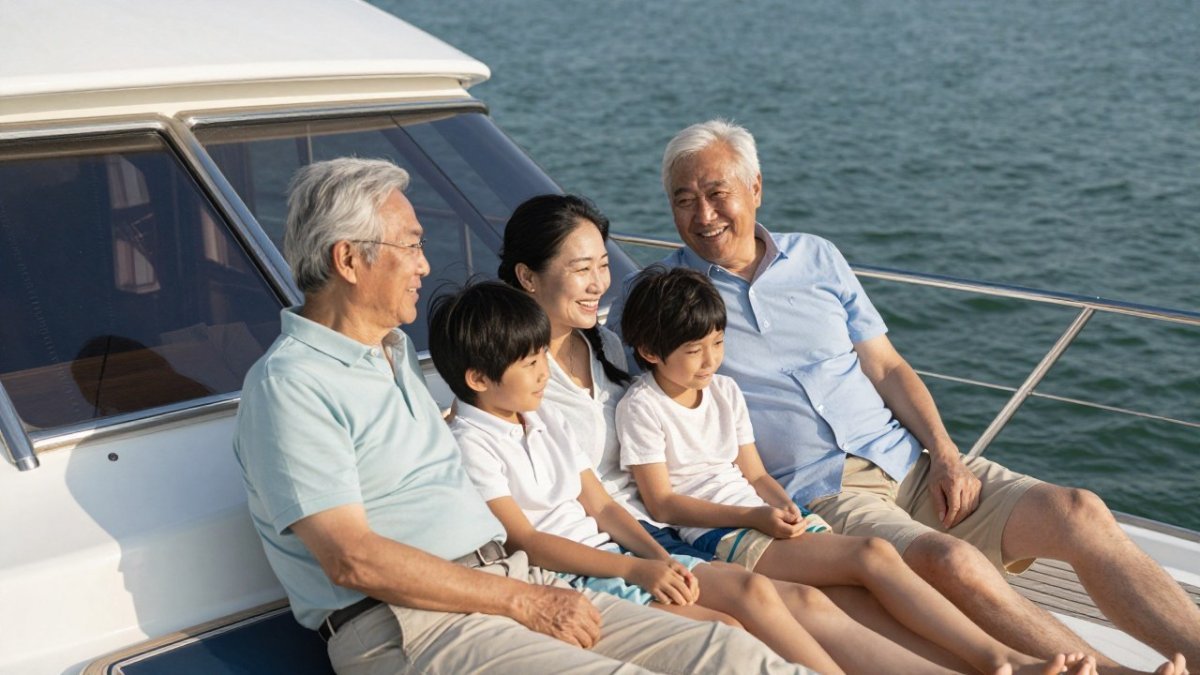
Boarding and moving around the boat
Ask how guests get on and off the vessel and whether the path from dock to deck involves steps, a ramp, or a gangway that shifts with the tide. A boat with a single narrow boarding point and steep companionway stairs is hard on guests with limited mobility, knee or hip issues, or anyone using a walker or cane. Confirm:
- Boarding method: ramp, gangway, or step-across, and whether crew assist each guest.
- Stairs: how many, how steep, and whether handrails run the full length.
- Deck surface: teak, fiberglass, or non-skid, and whether it stays walkable when wet.
- Head (bathroom) access: door width, threshold height, and whether the head is below deck down a ladder.
A guest who can board but cannot safely reach the head below deck will have a long day. Ask to see photos or a deck plan before you commit, and ask the operator to walk you through the route a grandparent would take from the dock to a shaded seat.
Child safety and age-specific planning
For toddlers and young children, the questions are different from those for adults. Most operators carry life jackets in children’s sizes, but confirm the size range and whether infant jackets are available, since a jacket that does not fit is not a safety device. Ask:
- Life jacket sizing: what sizes are on board, and whether you should bring your own for an infant or very small child.
- Supervision and water access: whether children can reach the swim platform or water unaccompanied, and where the crew draws the line.
- Sleeping and rest: for a day charter, whether there is a cabin or shaded area where a young child can nap.
- Sun and heat: how much covered space exists and whether the crew sets a shade plan for the hottest part of the day.
- Man-overboard plan: what the crew does if a child goes in the water, and how guests are briefed at the start.
Watch out: a “family-friendly” listing does not guarantee infant life jackets or a crew briefed on young children. Ask directly, and ask what the crew’s ratio of attention looks like when the boat is at capacity.
Mobility and medical needs across generations
Tell the captain about any guest with mobility limits, a recent surgery, balance issues, or a medical condition when you book, not on the morning of the charter. The plan can be adjusted in advance: a calmer anchorage, a shorter run, a seat near the helm, or a route that avoids a rough open-water stretch. Ask whether the vessel has a swim ladder with deep treads and a handrail, since that is what makes reboarding realistic for an older guest who is not a strong swimmer.
Matching the vessel to your group
Use the answers to build a short list. A group with toddlers and grandparents usually wants: one level or few stairs between the main seating and the head, generous shade, a swim platform with a proper ladder, and a crew that has handled young children before. A group of active adults and teens can trade some of that for deck space and water toys. Palm Beach Charters offers exclusive private boat tours, including specialized tours to Peanut Island.
Planning Timeline, Contingencies and Booking Your Reunion Charter
Start planning early. Popular dates, especially holidays and summer weekends, fill quickly, and a large group needs time to agree on dates, budget and the cost split. The timeline below works backward from your target date and gives each step an owner, because a reunion plan with no owner stalls. Giving each task an owner also keeps the family reunion planning checklist tied to the decisions that make a yacht charter workable for everyone.
A dated planning checklist
- Six to nine months out: Poll the family on a date range and a rough per-household budget. Assign one trip organizer who holds the booking and the deposit ledger. Confirm the headcount, including children and any guests who may join.
- Four to six months out: Request at least two itemized quotes for the same date range and group size. Compare line items, not headline rates. Shortlist two vessels and ask the accessibility and child-safety questions before you decide.
- Three months out: Agree the cost split in writing and collect deposits. Book the vessel and put the deposit down. Confirm the cancellation and weather terms in writing.
- One to two months out: Confirm the itinerary, food plan and extras. Send the captain the list of guests with mobility limits or medical needs. Set the meeting point and time and share it with every household.
- One to two weeks out: Reconfirm the headcount, collect any remaining balances, and send a packing and what-to-bring note (layers, sun protection, non-slip shoes, any personal medication).
- Day before: Check the marine forecast, confirm the departure time with the operator, and remind guests where to meet.
Group decision-making and cost sharing
Reunions fail on logistics more often than on the water. A simple process prevents most of it. Have the organizer gather preferences with a short poll (date range, budget ceiling, must-have activities, dietary needs), then set a budget ceiling before quotes arrive so the group is choosing within a range rather than reacting to the first number. Decide the split early: equal shares across adults, shares by household, or a contribution from the organizer with the rest split among attendees.
Contingencies: weather, seasickness, medical needs and cancellations
Build contingencies into the plan before you book. Ask the operator, in writing:
- Weather: what wind and sea conditions trigger a delay or cancellation, whether a rain date is available, and whether a weather cancellation is refunded, credited, or rescheduled.
- Seasickness: whether the route can be adjusted to calmer water, and what the crew recommends for guests who are prone to it.
- Medical needs: where the nearest medical facility is relative to the route, and how the crew communicates an emergency to shore.
- Itinerary changes: whether a stop can be swapped on the day and whether that changes the price.
- Cancellation terms: the refund schedule by date, and what happens if the group size drops after the deposit is paid.
Keep a backup plan for shore activities in case the water day moves, and make sure every guest knows the meeting point and time and who to call if plans change. To discuss a reunion charter for your group and get a written quote for your dates, contact Palm Beach Charters directly.
Frequently Asked Questions
How do you plan a family reunion yacht charter?
Start by setting a headcount, a date window and a total budget, then choose between a crewed and a bareboat charter. Ask each family branch to confirm attendance early, since cabin count and vessel size depend on it. Decide who coordinates payments and collects each person’s share, and agree on meals, activities and a backup date for weather. Send the final itinerary to everyone two to three weeks before departure so no one is surprised by the schedule or packing needs.
How many people can a private yacht charter accommodate?
Capacity depends on the vessel. Confirm the number of staterooms, berths and bathrooms before booking, because a headcount that fits on deck may not fit in the cabins overnight. Palm Beach Charters can advise on which vessel suits your group size; contact the company for current availability and a quote.
What is included in an all-inclusive yacht charter?
Ask for a written list that names meals, beverages, gratuities, docking fees and any excursions, and review the inclusions line by line so the final invoice matches what you expected to pay.
Are crewed yacht charters suitable for children and older adults?
Crewed charters are often the easier option for mixed-age groups because a captain handles navigation and a crew member can assist with boarding, meals and safety. Ask the operator about the vessel’s accessibility features for older guests and young children before you book. Life jackets in child sizes should be confirmed before the trip.